Layout Image
Page 1 of 212
Print This Post Print This Post
Electrofishing, Field Crew, Other Fish Species

Sacramento Pikeminnow

What more fitting place to catch a Sacramento pikeminnow than on the Sacramento River, a short swim from the Sacramento Airport. We scooped up this massive native minnow (Ptychocheilus grandis) during an electrofishing survey as part of our project to monitor repaired levee sites on the Sacramento River. We’re especially interested in the abundance of this ravenous fish because it predates heavily on juvenile salmonids (see Survival of the biggest). Although hefty, this particular specimen is far from record breaking: Sacramento pikeminnow can grow to more than 1 m (3.3 feet) in length. We’ve seen a few other mega-sized pikeminnows in our day – with mouths to match (see Hotlips).

Print This Post Print This Post
Electrofishing


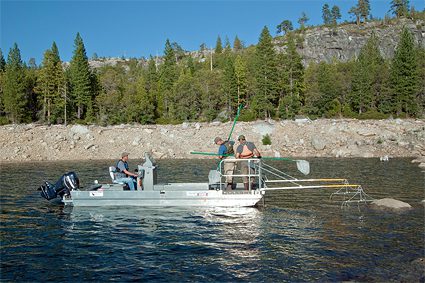
 What do you do when your electrofishing boat breaks down in the middle of a time sensitive research project and it’s going to take a week to get the parts needed for repairs? Build a replacement. That’s exactly what we did. With a little technical help from our friends at Smith-Root, we retrofitted one of our smaller boats with a Streambank Generator Powered Pulsator. Working well beyond normal hours, our master fabricators were able to construct a guardrail, mount fiberglass poles to suspend the electrode arrays, install floodlights, and wire-up all the electronics that make an electrofishing boat operate. Thanks to a dedicated team of people we were back on the water in less than 24 hours, catching the fish needed to complete our study.

Print This Post Print This Post
Electrofishing

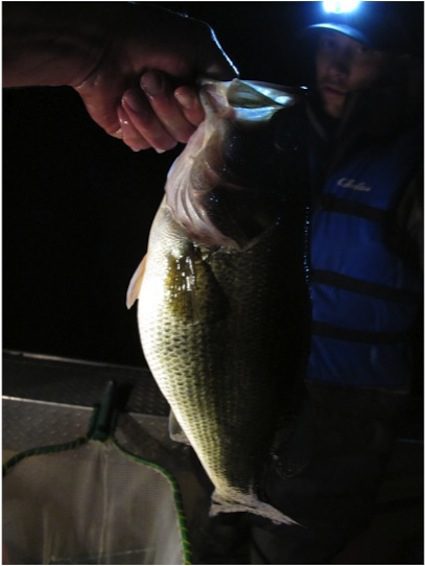
Last week we conducted electrofishing in New Bullards Bar Reservoir as part of a Federal Energy Regulatory Commission (FERC) relicensing assessment. FERC is the government agency that regulates and monitors hydroelectric projects and fisheries research is often required during relicensing of hydropower projects. The purpose of the study was to provide information concerning the distribution, occurrence, and condition of fishes in the reservoir. In this case, we conducted the electrofishing at night since it yielded a greater diversity of species and number of fish, and also reduced impacts of the project on recreational users. Another perk of conducting our sampling at night is that it left the day free for taking in the local sights.

New Bullards Bar Dam, which stands 645 ft. above the canyon floor, is touted as the 2nd tallest dam in California and the 5th tallest in the United States (Oroville Dam is the tallest at 770 ft.). It is quite an impressive site to look over the side of the concrete monolith into the canyon that once held the full force of the North Fork Yuba River. Some water is released at the base of the dam to support the fishery below, but the majority of the water now travels 4.7 miles through an underground tunnel to the New Colgate Powerhouse. New Bullards Bar Dam was constructed by the Yuba County Water Agency as a flood control reservoir in response to the flood of 1955. The dam was completed in 1969 and provides 170,000 acre feet of flood control storage space. Unlike many similar dams, people are still allowed to travel across this structure and gain an appreciation for its massive scale.

Print This Post Print This Post
Electrofishing, Monitoring

Armed with a half-dozen backpack electrofishers, a crew of “netters” and “shockers” waded through the Lower Kings River last week in search of rainbow trout. FISHBIO assisted with multi-pass depletion electrofishing efforts as part of the Kings River Conservation District’s (KRCD) annual rainbow trout population study in the Kings River below Pine Flat Dam in California’s Central Valley. The annual monitoring is preformed to assess the response of the trout population to habitat enhancements conducted over the past decade, as required by the Federal Energy Regulatory Commission (FERC). The Kings River Fisheries Management Program (KRFMP) has implemented extensive gravel augmentation, boulder placement, side channel enhancement, and riparian planting. The KRFMP is a partnership between the Kings River Water Association (KRWA), California Department of Fish and Game (CDFG) and the KRCD working to enhance and maintain a sustainable trout fishery on the lower Kings River.

Print This Post Print This Post
Electrofishing, Monitoring

Backpack electrofishing has been a common tool for sampling salmonids for decades. Similar to the snorkel surveys we use in deeper rivers, backpack electrofishing is often used to estimate the abundance of fish in a shallow river or stream. During this process, there are teams composed of a “shocker,” the person operating the electrofishing unit, and at least one “netter” to quickly scoop up the momentarily stunned fish. The number of teams depends on the width of the stream, since the teams form a line and move together upstream as they shock. The goal of staying in line is to ensure uniform sampling effort across the width of the stream and to prevent fish from slipping back downstream behind the shockers. There are several assumptions associated with this abundance estimation method (Temple and Pearsons 2007), including the important assumption that the fish are in a “closed population.” Essentially, we assume that as the teams pass upstream and sample, the fish are not eluding capture by moving further upstream. To avoid this, we place a block net at the top and bottom of the stream segment, temporarily trapping the fish. Of course, there are always some fish that elude capture the during the first pass upstream; thus, a common method is to use three or four passes in each stream segment to account for this, a technique called “depletion” or “multiple-pass” electrofishing.

Print This Post Print This Post
Electrofishing

If you’ve been following our blog posts over the years then you know we have done our share of electrofishing. With the right study design and procedures electrofishing can be an effective means of evaluating fish composition and abundance. For example, sampling equipment such as traps and seine nets are designed to capture a certain size or type of fish, and sampling with these gear will only provide data on part of the fish community. By employing standardized assessment methodology such as grid point or continuous electrofishing, fish in the sampling area will generally have a similar chance of being captured and the data will be more robust. We are currently utilizing electrofishing, as well as other methods, to evaluate fish abundance and community structure on the lower Sacramento River at sites where the U.S. Army Corps of Engineers has repaired levees. A key objective in the study is to identify features of levee repair sites that maximize fish use and provide the greatest value to listed species.

We are excited to announce the addition of Dr. Michael (Mike) Holliman, Senior Research Biologist and internationally recognized electrofishing expert to our team. Mike is perhaps the only scientist in North America with a PhD in electrofishing theory and principles, and has extensive experience using electromagnetic resonance imaging and x-ray technology for assessing potential fish injuries from electric fields during electrofishing surveys. He brings advanced quantitative expertise, electofishing theory and management skills to our growing staff.

Print This Post Print This Post
Electrofishing

First off, these aren’t Ghostbusters exterminating ghosts, this field crew is all decked out for a mission to rescue fish. Our previous experiences with fish rescue at the Tehama-Colusa Canal Authority Fish Passage Improvement Project in Red Bluff have taught us to always expect the unexpected. In December, we found ourselves electrofishing from a boat inside a cofferdam (Water + Steel + Electricity = ?); and in January, we slogged through waist-deep mud (A Muddy Situation). Last week, we knew we were in for another adventure when they warned us that we would be receiving ‘Confined Spaces’ training prior to conducting the rescue. We arrived at the site to find that the roughly 400 foot-long cement siphon tunnels under construction were flooded during the recent high flows. As the water receded, fish, mud, and some debris were trapped in the tunnels. After receiving training on how to safely operate in a confined space, we entered the tunnels armed with our safety gear and our atmosphere monitor that would alert us of potentially hazardous changes in the air we were breathing. We used a backpack electroshocker, a seine net, and hand nets to corral and capture the fish, which was definitely easier said than done. The quicksand-like mud that hampered our last rescue operation was still present, and we had the additional challenge of working in the dark. Once the fish were captured, they were hauled in buckets over the 30 foot cofferdam walls and released into the Sacramento River. There’s no telling what we might encounter on our next trip.

Photo source: FISHBIO

Print This Post Print This Post
Electrofishing, Field Crew

Recently while conducting electrofishing on the lower Sacramento River we had a little mechanical malfunction. Fortunately for us we have crewmembers that are excellent at collecting scientific data but also have the ability to dismantle and rebuild a boat motor on the fly. It’s handy to be handy.

Photo source: FISHBIO

Print This Post Print This Post
Electrofishing

What better place to attend school, but on a boat in the Sierra foothills? FISHBIO is hosting a training course this week, Boat-Based Electrofishing: Principles and Practices, and a fortunate break in the weather is providing pleasant conditions. Participants are presented information concerning topics such as electric circuit and field theory, safety training, and fish injury awareness and minimization. They are also given the opportunity to hone their newly acquired skills in the field.

The Northwest Environmental Training Center is conducting the class, and attendees include representatives from FISHBIO, California Department of Fish and Game (CDFG), Department of Water Resources (DWR), Sonoma County Water Agency (SCWA), Nebraska Department of Environmental Quality (NDEQ), as well as some tribes and other private consultants. The course meets the National Marine Fisheries Service (NMFS) training requirements for electrofishing in waters containing salmonids listed by NMFS under the Endangered Species Act (ESA).

Photo source: FISHBIO

Print This Post Print This Post
Electrofishing

scott-muddy

We returned to Red Bluff to conduct a final fish recovery effort and found ourselves in quite a muddy situation. The cofferdam for the Tehama-Colusa Canal Authority Fish Passage Improvement Project was completed, and the isolated areas were drained of water to prepare for the next phase of construction. As described in an earlier post, Water + Steel + Electricity = ?, dewatered areas must be sampled to capture and relocate any stranded fish. Fish recoveries are quite different from the usual fish abundance sampling, requiring a bit of ingenuity and flexibility.

siphon-chamber

The FISHBIO crew used a backpack electroshocker, seine nets, and hand nets to capture Sacramento pikeminnow, prickly sculpin, and black bullhead. Then, buckets tied to ropes were used to haul the fish 30 ft. up the side of the cofferdam for release into the main stem of the Sacramento River.

stuck-in-the-mud

After a full day of slogging around in the mud, we were ready for a hot shower and a hearty meal.

Photo source: FISHBIO