

Wednesday October 8, 2025
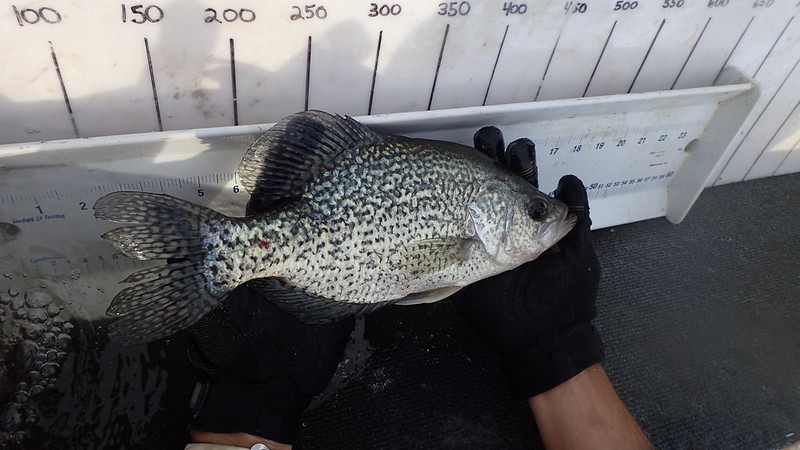
Common names: White Crappie
Scientific name: Pomoxis annularis
Native range: Central United States
Status: Least Concern
Habitat: Slow-moving freshwater
The white crappie (Pomoxis annularis), a member of the sunfish family Centrarchidae, is a freshwater fish and one of two species of crappies. This species occurs natively in the southern Great Lakes, Hudson Bay, and Mississippi River basin, but can be found in almost all other continental states. They have a long jaw and an olive-colored back that turns to a silver-white on the sides. Breeding males appear darker in color, especially on the head and breast, which can become nearly black. White crappie were successfully introduced to California, north of the Tehachapi Mountains, in 1951. Typically, they are found schooling around submerged logs or boulders, except when they move into open water to feed. White crappies consume a variety of food items, including insects, small crustaceans, minnows, and young shad. White crappies reach maturity in their second or third spring, at approximately 10 to 20 cm in total length. Females can lay between roughly 970 and 326,000 eggs per season. In California, white crappie exhibit a slower average growth rate than in other parts of their range, with few individuals living more than 8 years or exceeding 35 cm in fork length.
Fun Fact: White crappie are sometimes called “sac-a-lait”, meaning “sack of milk” in cajun French, in reference to the color of their meat.