

Monday August 4, 2025
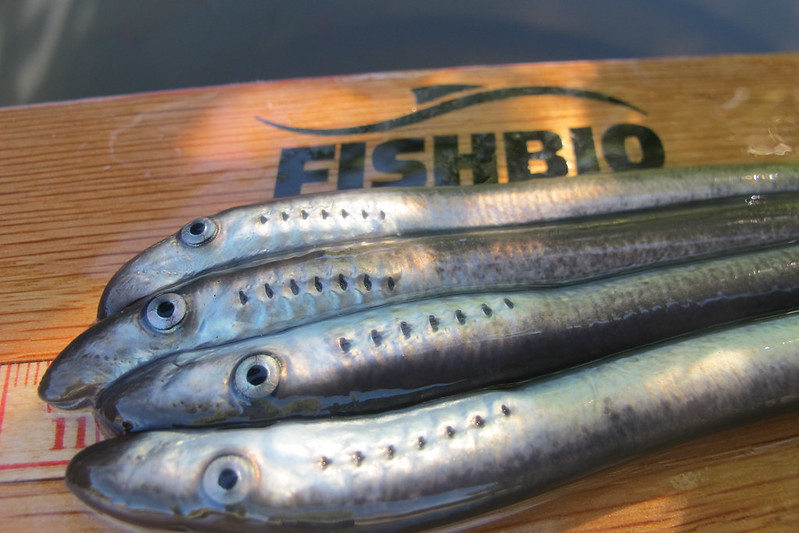
Lamprey are a fascinating and ancient fish that are often overlooked, yet they play an important role in both ecosystems and Indigenous cultures along the Pacific Coast. Historically, their unique physiology allowed them to scale waterfalls and access remote spawning habitats that were unreachable to many other fish. In fact, lamprey have survived for over 360 million years – and the oldest known fossil of a jawless fish is from 470 million years ago. Jawless fish as a group have survived all five mass extinction events, displaying their resilience and making them among the earliest known vertebrates.
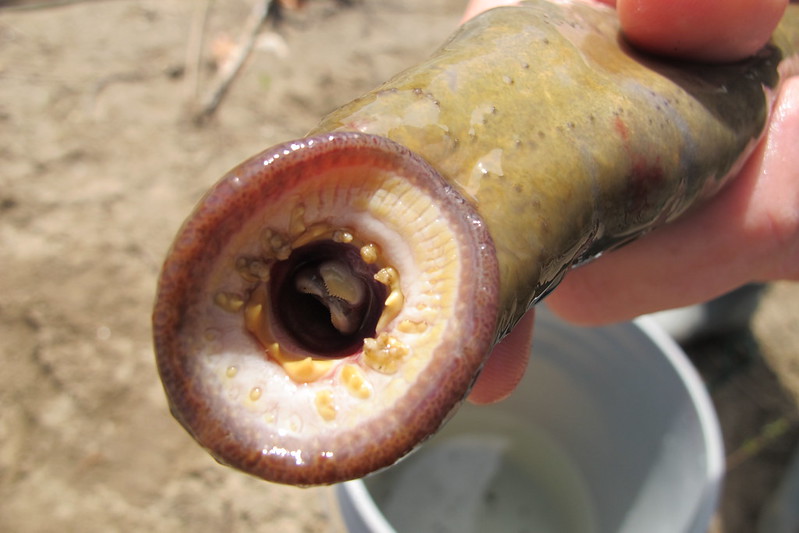
Like salmon, Pacific lamprey (Entosphenus tridentatus) are anadromous: they hatch from eggs in gravel nests called redds, spend up to seven years as filter-feeding ammocoetes in freshwater, then metamorphose into their adult, parasitic form. In the ocean, they attach to fish and marine mammals, feeding on blood and tissue. After one to three years at sea, they return to freshwater to spawn and complete their life cycle.
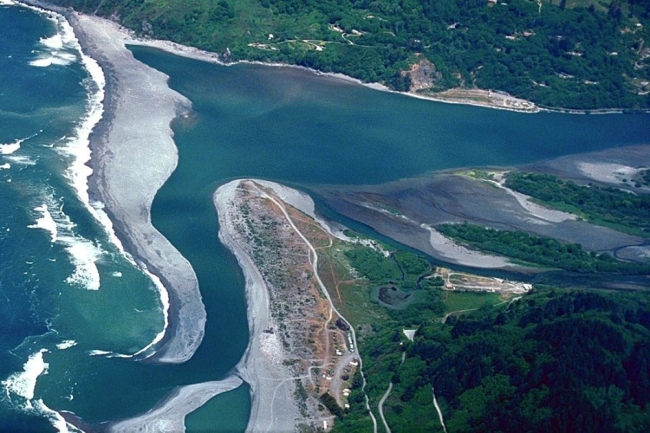
At the mouth of the Klamath River, this ancient fish reveals a deeper story of resilience and hidden diversity. Research led by Yurok Tribal Senior Fisheries Biologist and Cal Poly Humboldt lecturer, Keith Parker, uncovered genetic evidence of two distinct life history types in Pacific lamprey (Parker et al., 2019). In the 2019 study, Parker and colleagues identified two maturation ecotypes in the Klamath River population. These are distinct groups within a population that have evolved behavioral adaptations as a result of differing environmental conditions. The river-maturing ecotype – called key’ween in the Yurok language – enters freshwater and holds for up to a year before spawning. In contrast, the ocean-maturing ecotype – or tewol, from the Yurok word for ocean – enters freshwater ready to spawn almost immediately. Although their behaviors differ, both lamprey ecotypes belong to a single, interbreeding population.
This resident freshwater behavior might sound familiar as it mirrors similar patterns found in other species, such as steelhead trout, that exhibit different migration strategies shaped by both genetic and environmental factors. However, in steelhead, these strategies are thought to be driven by a single gene, while in lamprey, the underlying genetic processes appear to be made up of more complex interactions.
Scientists found that two specific regions of the genome help determine whether a lamprey matures early or late, but it isn’t a simple on-off switch. The interaction between these genes follows a pattern called duplicate dominant epistasis: a dominant allele at either locus (the specific location of a gene on a chromosome) produces the river-maturing form, while only individuals with recessive alleles at both loci develop into ocean-maturing fish.
This suggests that the river-maturing ecotype carries more genetic diversity – like an evolutionary tool kit with unique tools – while the ocean-maturing form may be more genetically uniform. However, not all fish fit neatly into ecotypic categories. The researchers used egg mass as a proxy for spawning readiness, but because egg size varied continuously and may reflect developmental stage rather than ecotype, this measure may have limited accuracy.
Interestingly, despite behavioral differences, there is no evidence of genetic separation between the two ecotypes. This means river- and ocean-maturing lamprey freely interbreed, maintaining their diversity within a single population. Both types were also observed entering freshwater simultaneously, suggesting overlapping migration timing rather than distinct spawning seasons.

The study also identified a strong genetic link between a different region of the genome and body size, a trait important for survival and reproductive success. Surprisingly, egg size and body size were not strongly correlated in Pacific lamprey. However, across their range, various publications reference a relationship between body size and egg mass among different ecotypes – such as day eels and night eels, normal and dwarf, and river- and ocean-maturing forms. These collective patterns led researchers in this study to hypothesize that a single gene region may influence ecotype variation, with regional environmental conditions shaping how that variation is expressed.
Pacific lamprey are ecologically critical and culturally sacred. They cycle marine nutrients into freshwater ecosystems, serve as food for other wildlife, and hold deep spiritual and subsistence value for Indigenous peoples, including the Yurok Tribe. Recognizing the genetic and life history diversity within this species enhances our ability to conserve both its ecological function and its cultural legacy.
Header Image Caption: Larval stage Pacific lamprey, called ammocoetes, are born without eyes and teeth, which slowly grow as they metamorphose into their adult form.
This post was featured in our weekly e-newsletter, the Fish Report. You can subscribe to the Fish Report here.