

Monday July 7, 2025
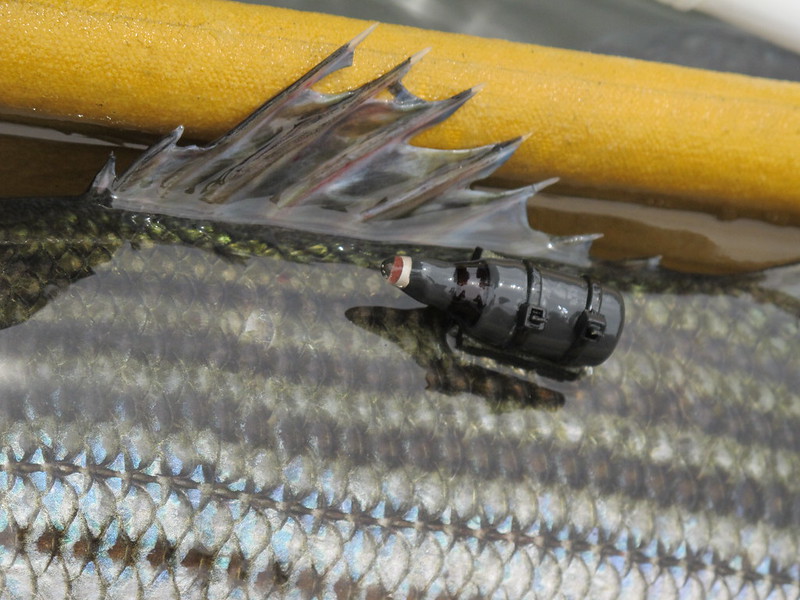
Understanding the ecology of the underwater world, especially aquatic animal movement and behavior, would be nearly impossible without modern tagging and tracking technologies. Such information can be studied using various animal-borne tracking and data logging technologies, which are often funneled into two categories: biologging and biotelemetry.
Both biologging and biotelemetry techniques require implanting or externally attaching sensors to the animal, with the key difference between the two being onboard data storage capabilities. Biologging devices continuously log and store data within the tag, which cannot be retrieved until the animal and/or tag are recaptured. Contrastingly, biotelemetry tags transmit data using a variety of radio, satellite, or acoustic signals, which can be accessed remotely. Once a biotelemetry tag is deployed, scientists can follow long- and short-term animal movements, even collecting information on surrounding environmental characteristics without ever leaving their desks.


Biotelemetry tags transmit data using a variety of signals, including satellite (left) and acoustic (right). Tags can come in all shapes and sizes.
Fisheries scientists often use biotelemetry to investigate fish migration routes or make population estimates, while marine biologists might employ biologging methods to study vertical habitat use in ocean fishes or collect environmental data from deep sea animals. Recently, scientists have widened the scope of movement ecology to predict future impacts of climate change on aquatic animals and their ecosystems, informing species conservation methods. In 2024, a group of international researchers reviewed current applications of aquatic fish and animal tagging, finding that collections of long-term tracking data analyzed through the lens of a climate scientist could bolster current conservation measures and help develop interventions to aid aquatic animals affected by the impacts of the climate crisis.

In the face of negative environmental change, an aquatic organisms’ first line of defense is often a behavioral response. Tracking an animal’s behavior, including patterns in movement, interactions with prey and predators, and habitat use, under changing or extreme conditions can offer critical insights to their conservation. A study in the review analyzed existing satellite tracking, temperature, and depth data from satellite telemetry tags to predict loggerhead turtle (Caretta caretta) resilience in warming waters of the Atlantic Ocean. Using a combination of these data, biologists monitored habitat use and characterized suitable water temperatures in the turtles’ native range. They input the species’ habitat use patterns into global climate models to project loggerhead turtle temporal and spatial presence in their native range up to 80 years into the future. These projections revealed a probable northern shift in suitable habitat, potentially prompting increased conservation measures in the new range. These approaches can be applied to many imperiled species and provide an opportunity to identify and preemptively combat a species’ future climate vulnerabilities.

Tracking animals and their habitat use can also streamline and inform restoration and rehabilitation measures like assisted species migrations, translocations, or reintroductions. While these efforts have potential for great success, they are often overlooked or avoided due to daunting costs, prohibitive field logistics, and the uncertainty of ecological viability. Another study highlighted in the review used a combination of biotelemetry and biologging to evaluate the viability of the assisted colonisation (a type of translocation) of Australian western swamp turtles (Pseudemydura umbrina), a rare species with limited suitable habitat. The turtles were tagged with radio telemetry tags and temperature loggers and introduced into a wetland located 300 kilometers south of their native range. Movement, temperature, growth rate, and survival data collected from the tagged swamp turtles revealed that juveniles could achieve viable growth rates in a cooler, southern location, ultimately confirming that rehoming the species was possible and serving as a framework for the introduction of other imperiled species to more suitable locations.
Tagging technology is a work in progress with limitations in tag retention, battery life, and the ability to repeatedly capture tagged animals for data retrieval. Nonetheless, it is an interdisciplinary tool that informs fields of study like climate modelling, fisheries management, and marine species conservation, among others. The findings of this review breathe new life into species management approaches amidst the impacts of a changing climate.