

Monday April 27, 2026
After the longest multi-year commercial fishery closure in California’s history, the Pacific Fishery Management Council’s (PFMC) recent decision to open the 2026 salmon fishery allows recreational and commercial fishers to take to the seas again. Since the first Chinook salmon population collapse almost two decades ago, spawner abundance (“escapement”) in Central Valley (CV) rivers has been on a long road to recovery. Salmon escapement has often fallen short of management goals because of stressors like drought, high water temperatures, pressure from non-native species, and decreased habitat suitability and connectivity. These declines have generated enough concern from fisheries managers that the fishery was closed for an unprecedented three years (2023 to 2025). With more optimistic forecasts this year, we are excited to present our annual review of key findings from the previous years’ salmon population, illuminating how CV Chinook salmon are faring in response to management decisions.
Preseason Predictions
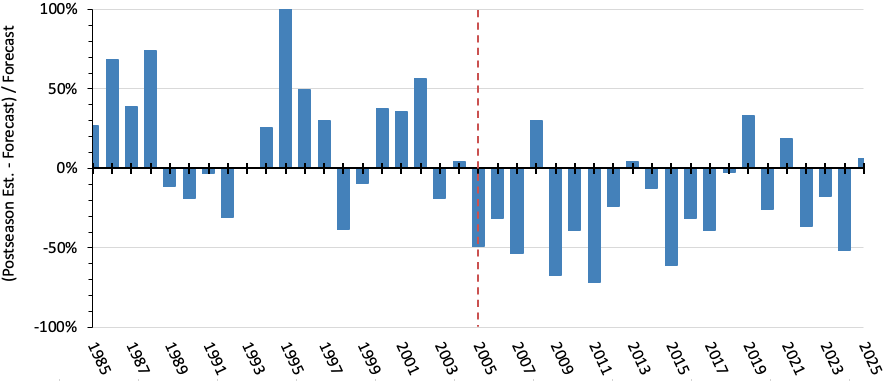
Each spring, the PFMC publishes a report on the previous year’s salmon fisheries along the West Coast, detailing harvest totals and socioeconomic benefits from California’s ocean fishery. It also includes escapement totals and allows us to compare these numbers with preseason predictions used to set harvest regulations. Inaccurate preseason predictions can have severe consequences. An underestimation can impose unnecessary restrictions on the commercial fishery, while an overestimation can lead to erroneously high quotas and overharvest, leaving fewer fish to return to California’s rivers. Since 2005, CV salmon abundance has been overestimated in over 75% of years (Figure 1), which has reduced the number of fish returning to spawn. Fortunately, in 2025, the population was underestimated, with the escapement estimate exceeding the forecasted abundance by ~6%.
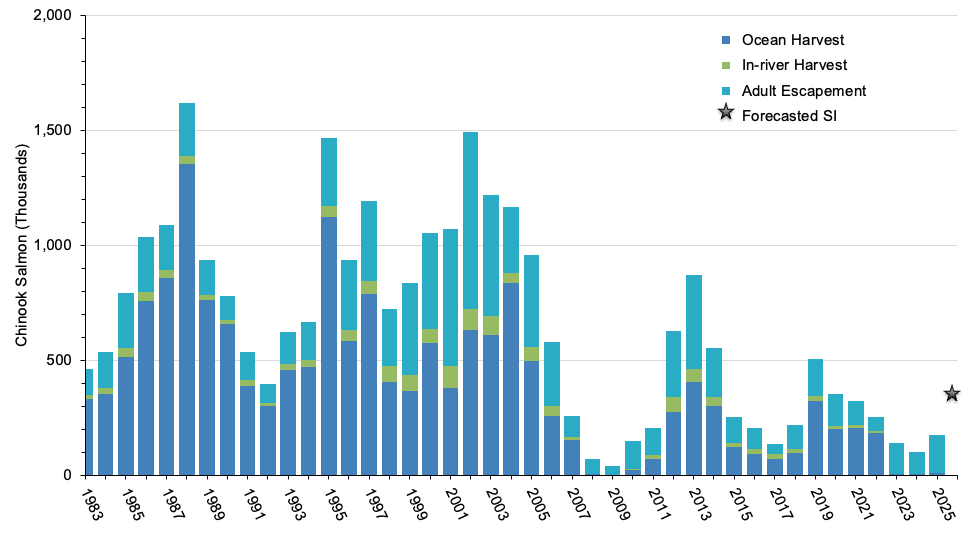
In California, the PFMC report highlights fall-run Chinook salmon (Oncorhynchus tshawytscha) in the Sacramento River Basin (SRB), as this population contributes most of the fish caught in the ocean fishery. The metric used to represent the abundance of this population is the Sacramento Index (SI), which is the total number of adult fish (ages three to five) available in the ocean that may be harvested or escape to spawn in rivers or hatcheries in the CV. The preseason forecast for 2025 predicted an SI of 165,655 fish, including a spawner escapement of 147,733 hatchery and natural area adults, which is within the range targeted by management for sustaining the population. The actual SI in 2025 was 176,417 fish, which is 42% higher than it was in 2024, but 32% lower than the average over the previous five-years of 233,655.
Central Valley Escapement
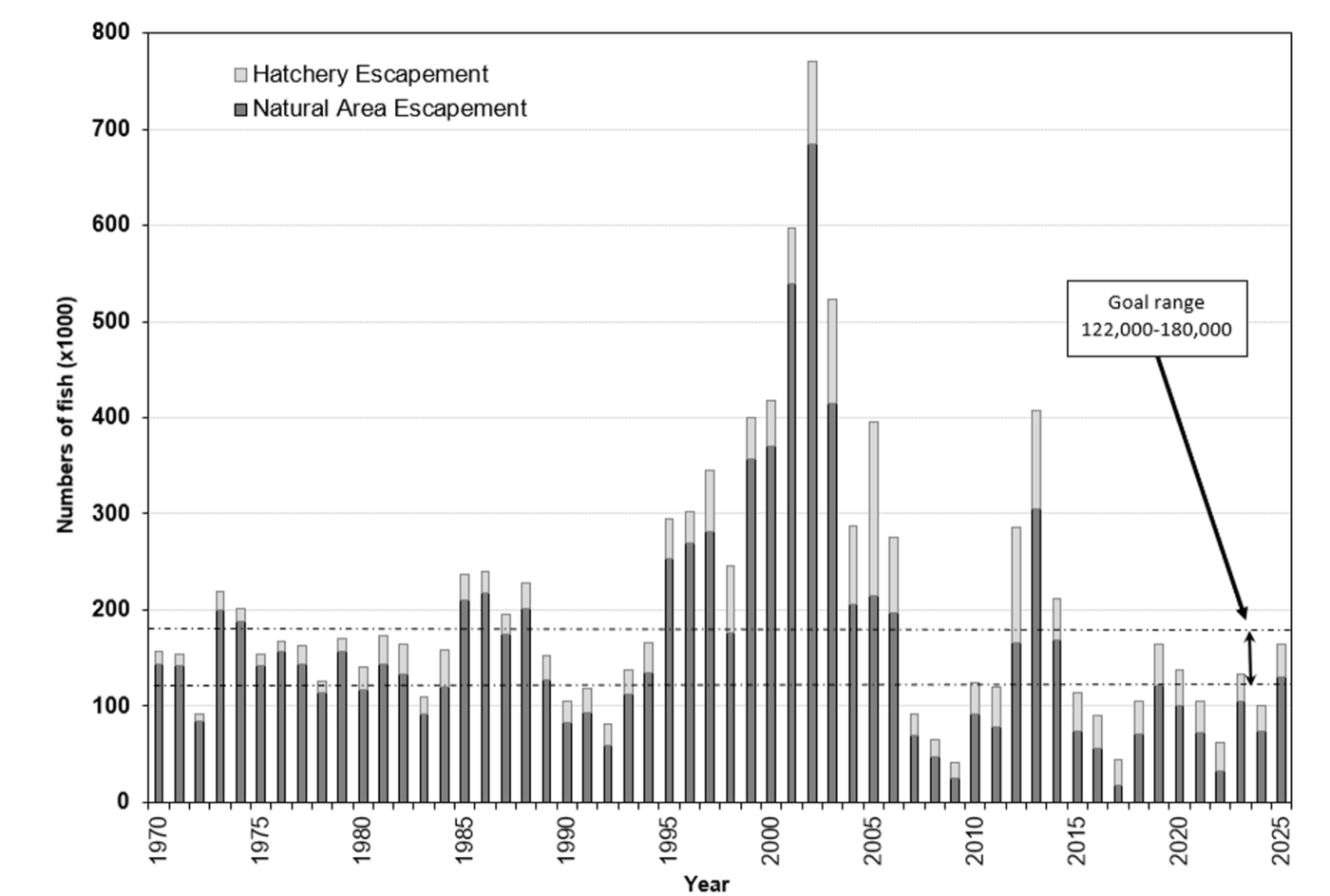
During the third consecutive year of the salmon fishery closure in California, few SRB-origin salmon were fish harvested in other states (6.6%), indicating that the majority of the salmon population returned to CV rivers and hatcheries to spawn. This indicates that the majority of the salmon population returned to CV rivers and hatcheries to spawn. This includes an estimated 164,763 fall-run Chinook salmon, exceeding the long-term management goal of 122,000 hatchery and natural area spawners. Escapement in 2025 was 65% higher than the previous year (100,152 fish) and 53% higher than the average from the previous five years (107,871; Figure 2).
The salmon returning in 2025 to the SRB likely benefitted from good conditions in 2023 (a wet water year), when most of the returning fish outmigrated to the ocean as juveniles. Even so, survival in the San Joaquin River (SJR) Basin is generally much lower than in the SRB. In 2023 and 2024, during the salmon season closure, SJR basin salmon escapement was the highest observed in over twenty years, exceeding 35,000 fish in both years. While this upward trajectory did not continue in 2025, the salmon returns were still strong with a total estimated escapement in the SJR basin of 21,272 salmon (~about 8.5% of the CV total). Most of these fish returned to the Stanislaus River, which received roughly 38% of all natural area spawners in the basin, followed by the Mokelumne (35%), Tuolumne (14%), Merced (11%), and the Calaveras and Cosumnes rivers (combined total of 1%).
The SJR Basin has historically contributed less than 10% of the total CV escapement, but in the last ten years, its average contribution is just over 15%. This increase may be partially attributed to increased trucking and release of hatchery smolts at off-site locations, which reduces outmigration mortality due to predation and other factors. The Mokelumne River Hatchery, for example, consistently trucks most of their fish production directly to the San Francisco Bay, boosting the number of returning adults to nearby rivers and streams. This increased proportion of SJR salmon could be attributable, in part, to the currently lower abundance of SRB salmon populations compared to runs of the late 90s.
Industry Impacts
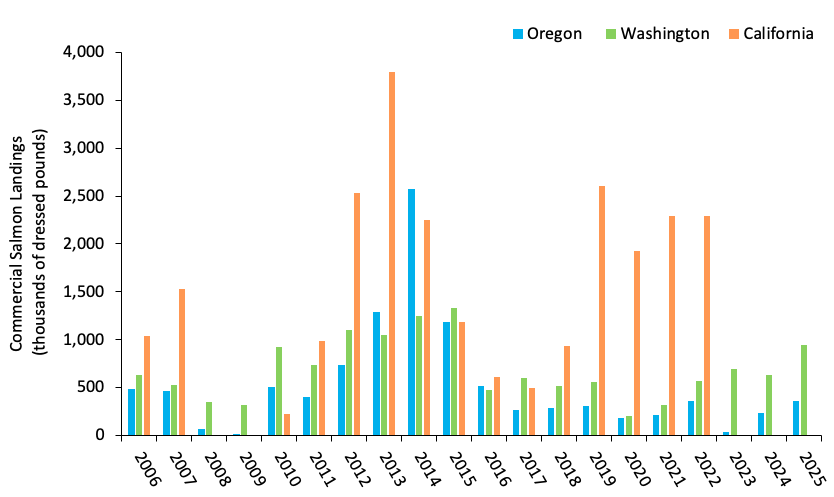
From 2019 to 2022, roughly 85% of Pacific Coast commercial Chinook (by weight) were landed in the Fort Bragg, San Francisco, and Monterey ports of California (Figure 4). With California commercial fishing halted, the majority of commercial landings now occur in Washington. The losses to California’s costal economies during the last three years have been estimated at over $100 million, far exceeding the governmental aid made available to buffer the impacts of the closure to this struggling industry.
Looking Forward
Current preseason forecasts anticipate about 392,000 Sacramento River fall-run Chinook salmon in the ocean this year. This is 137% higher than 2025’s projection and 61% higher than the previous five-year average. These improvements deserve celebration, but must be carefully considered within the context that, in the last 10 years, the lower end of the long-term salmon escapement goal range has been met or surpassed in only half of the years. Importantly, PFMC will be employing a new harvest management strategy that uses statewide and regional in-season harvest quotas to reduce the chances of overharvest. This strategy includes zone-specific landing limits per vessel and total harvest quotas, which can trigger a fishery closure once reached.
While the salmon fishery reopening may provide a boost to commercial fishers in California who have felt the impacts of the halted industry in recent years, it is a delicate win. The population has not yet stabilized at levels that warrant a return to business as usual, and individual vessel catch will be severely limited. After the three-year closure and multiple wet water years, the outlook for future salmon seasons off the California coast appears promising. The fisheries community—scientists, commercial fishers, and recreational anglers alike—is breathing a small sigh of relief at improved numbers but must remain diligent moving forward if this trend is to continue. Replacing business-as-usual with improved harvest management strategies, alongside continued salmon conservation measures, may be the key to keeping the salmon season open and maintaining salmon populations for generations to come.
This post was featured in our weekly e-newsletter, the Fish Report. You can subscribe to the Fish Report here.
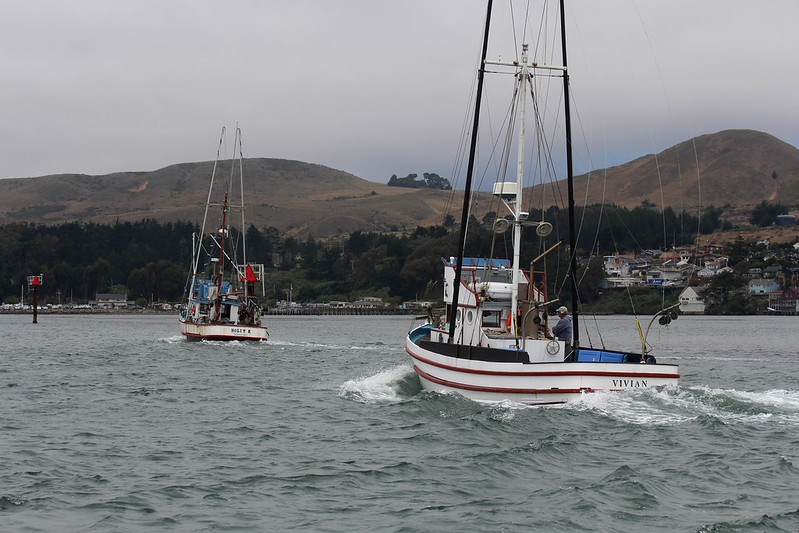
Header Image Caption: Salmon fishing boats