

Monday December 1, 2025
When you walk into an aquarium or plunge into the ocean, you meet an astonishing array of creatures we arbitrarily group under one simple word: fish. The stars clinging to rocks in the touch tank are “starfish,” and the drifting, gelatinous creatures are “jellyfish.” Yet neither are “fish” at all. Meanwhile, animals that look nothing like the streamlined, scaly shape you might picture – such as seahorses and eels – are fish. This contradiction leads to a surprisingly tricky question: What exactly is a fish, and why does the definition matter?
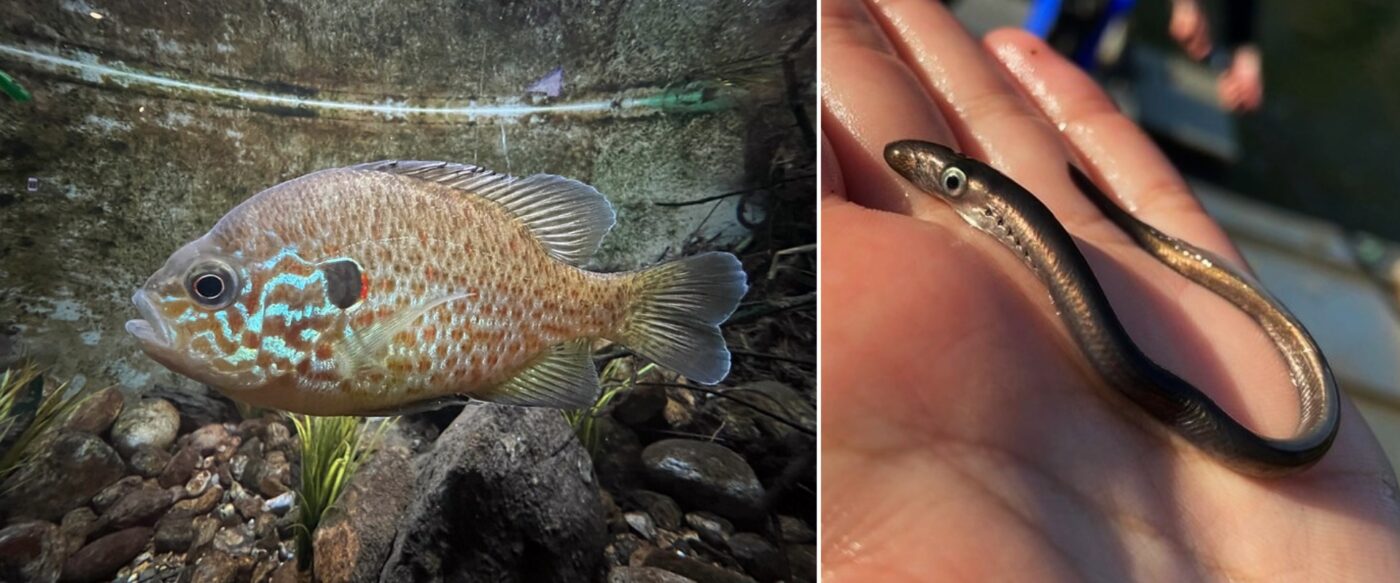
For centuries, “fish” was less a biological category than a catch-all label for aquatic organisms. As science advanced, the definition narrowed to encompass cold-blooded vertebrates with gills, fins, and streamlined bodies. But while this definition fits anchovies and sharks, it excludes other animals we consider fish. Tuna are partly warm-blooded, seahorses lack a streamlined body, frogfish are lumpy, and mudskippers can breathe air on land. Some fish even have fin bones resembling fingers, while hagfish and lampreys don’t even have jaws.
Legal definitions are even more vague and often lag behind scientific ones, sometimes bending in surprising ways. For example, under the United States Endangered Species Act (ESA), all invertebrates fall under the category of “fish”, even though no biologist would classify an octopus or a spider that way. This quirk allowed California to protect imperiled bee species by declaring them fish for conservation purposes. Strange as it sounds, the label has helped save species that might otherwise be overlooked.
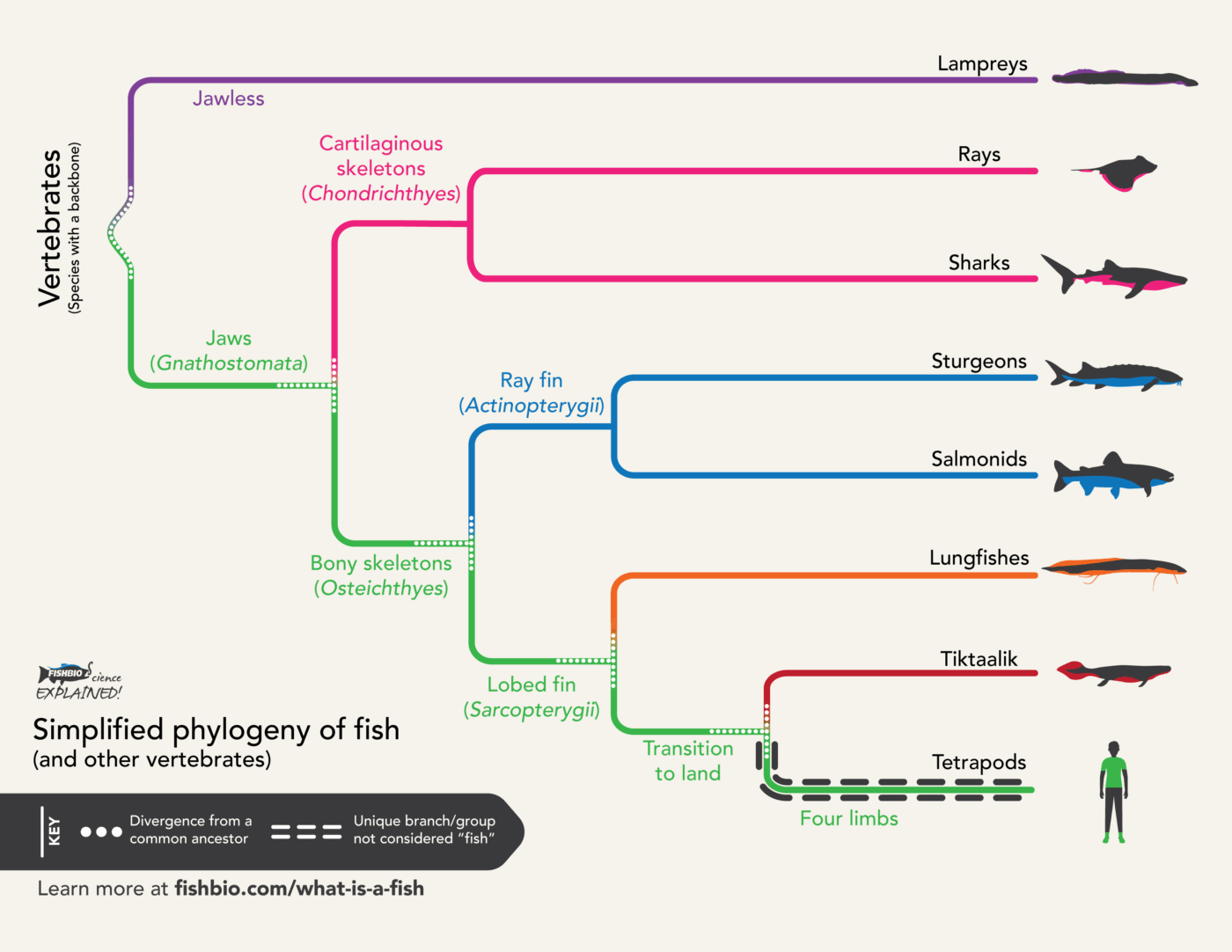
Since definitions based solely on one factor, like appearance, physiology, or genetics, get messy, scientists use evidence from all of these to reconstruct the evolutionary history of organisms, called phylogenies. Instead of asking “What traits do these organisms share?”, phylogenies ask “Who is related to whom?” This approach, however, is not straightforward either; fish are not a monophyletic group. Monophyletic groups include all descendents from a common ancestor. “Fish” is paraphyletic – a group that includes some descendents from a common ancestor. As vertebrates evolved, different lineages developed new traits at different times – jaws, bony skeletons instead of cartilage, lobed fins capable of supporting weight, and eventually four limbs for moving on land. The roughly 33,000 species we commonly call “fish” excludes tetrapods: the land-dwelling group that gave rise to creatures like humans.
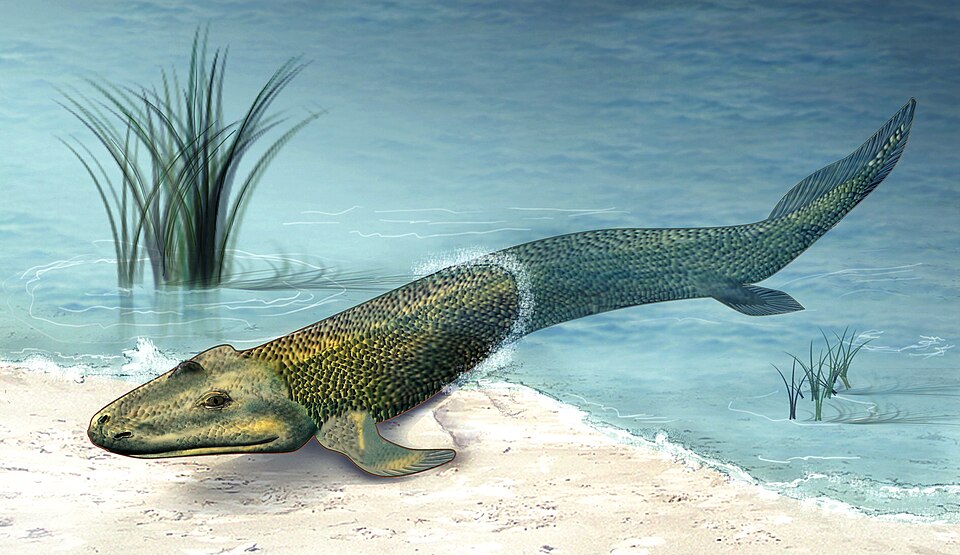
As tetrapods, humans nest within the fish lineage and share a common ancestor with them. Our shared ancestry also explains why human, reptile, bird, and fish embryos all display similar features: a vestigial tail, structures resembling gills, and webbed digits. As new fossils and data emerge, phylogenies continue to shift, revealing connections that reshape our understanding of vertebrates. The more we learn, the harder it becomes to draw a clean, scientific boundary around what counts as a “fish.” The everyday word still works for aquarium guides and grocery stores, but it is more like a convenient nickname than a true biological category.
If we all share a common ancestor and belong to the same giant group, then there is no clean point where “fish” stops and “human” begins. While in common usage, the two are distinct categories, in evolutionary terms, some fish are more closely related to humans than they are to other fish. The first creatures with true bones, the first jaws, the first limbs – all of them were fish. Your inner ear traces back to a fish’s balance organ. Your jaw is a modified gill arch. Your limbs are remodeled fins. Strip away millions of years of evolution and adaptation, and the blueprint of a fish still swims inside you. So next time you peer through the aquarium glass at the delightful creatures behind it, remember that you are one of them, too.
This post was featured in our weekly e-newsletter, the Fish Report. You can subscribe to the Fish Report here.
This story was written by Ananya Karthikeyan for an internship with FISHBIO through the UC San Diego Academic Internship Program.
Header Image Caption: Simplified phylogeny of fish displaying different branches/groups of vertebrates, including multiple groups of fish.