

Monday May 25, 2026
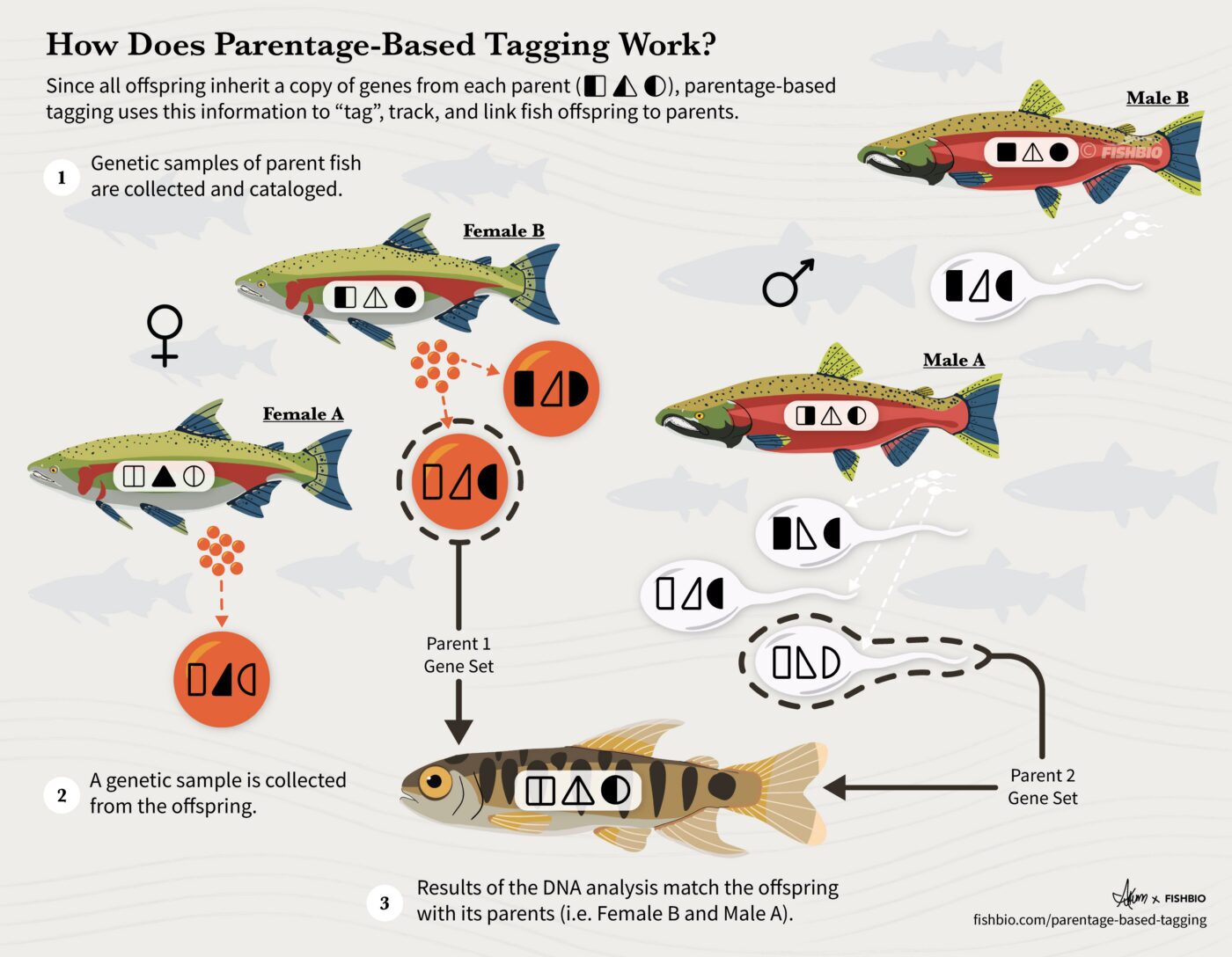
For decades, fisheries scientists have used coded-wire tags (CWTs) to recover valuable information about hatchery-origin salmon. These tiny pieces of wire are inserted into the snouts of juvenile fish. They are later recovered when the fish are harvested by fishers or after they return to freshwater to spawn. Once collected, CWTs reveal important information about each individual’s age and hatchery of origin. While effective, this approach has limits: CWTs can be lost, only a fraction of fish can be tagged due to size limitations, and recovering them usually requires sacrificing the fish if it is not found already dead. A now widely used method called parentage-based tagging (PBT) has been changing how managers track hatchery fish. Instead of a physical tag, PBT relies on the genetic code of a salmon to act as a “tag” that is carried naturally in the fish. This tag is a unique genetic sequence that allows scientists to determine the parents of a salmon and information like its hatchery of origin and age.
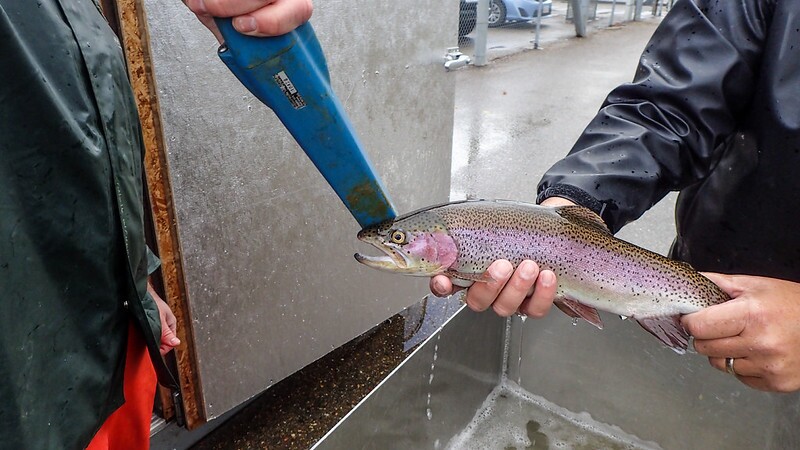
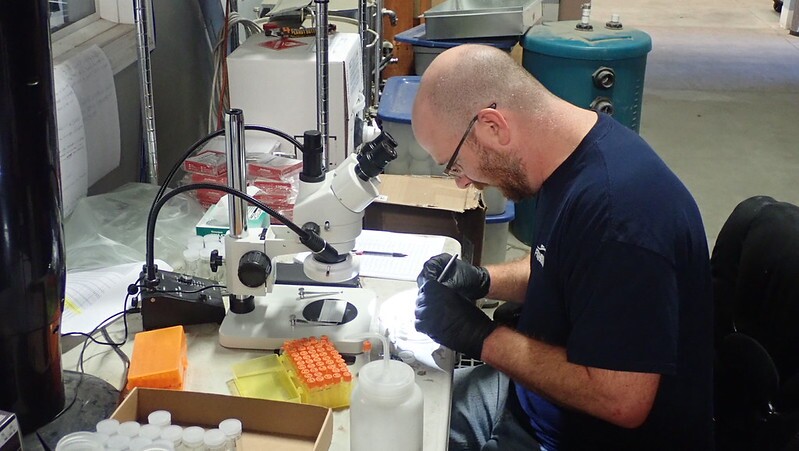
The PBT process begins with collecting DNA from all parent fish (broodstock) in the hatchery and creating a genetic database. When the broodstock spawn, their offspring inherit a copy of genes from each parent, creating a unique genetic fingerprint in each offspring. Later, if those offspring are caught in a fishery or found in a river, a small fin clip sample provides DNA that can be compared against the broodstock database. This allows scientists to identify which parents and which hatchery produced the fish as well as the year it was born.
One strength of PBT is that if all broodstock are sampled in a hatchery, then every fish released is “tagged” and there is no risk of losing the tag because it is encoded in their DNA. This technique also allows managers to recover information non-lethally, which is especially important for threatened and endangered species. Like any method, PBT has its challenges, and the ease of the technique is dependent on having a complete broodstock DNA catalog. If some broodstock are missed, their offspring are more difficult to assign back to parents. Maintaining these databases requires consistent sampling and genotyping each year. Setting up the infrastructure—including developing genetic markers, maintaining a laboratory, and being able to process high volumes of data—also requires an upfront investment.
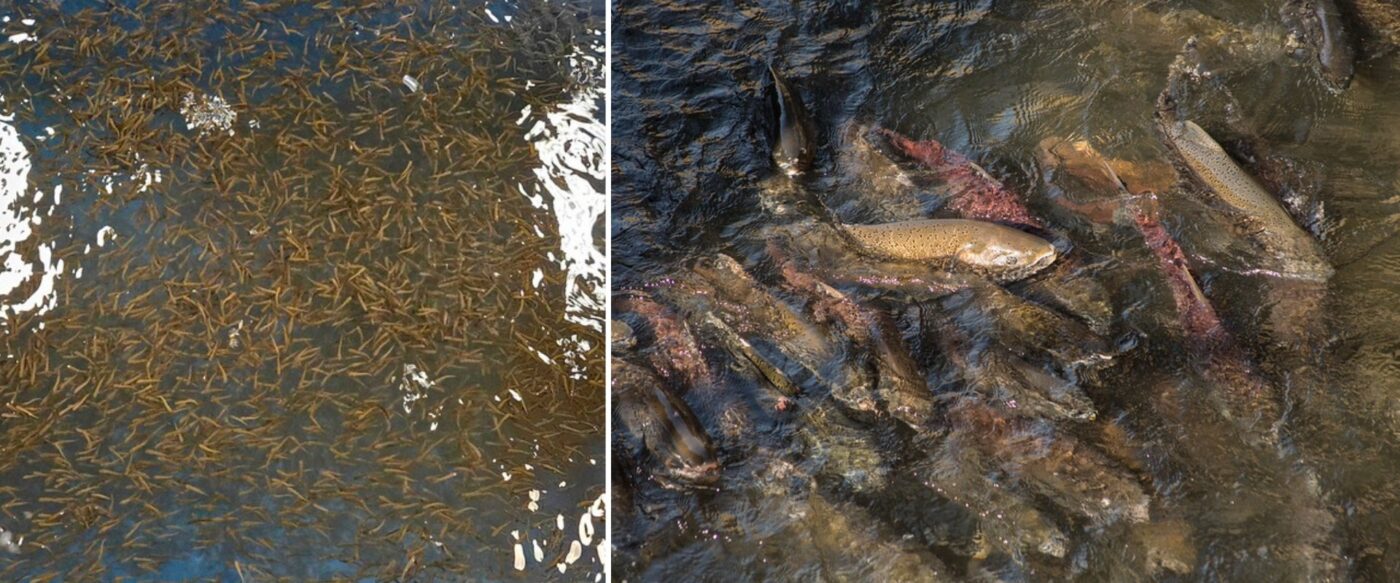
The use of PBT is expanding in fisheries science. In British Columbia, researchers found that combining PBT with genetic stock identification provided a cost-effective alternative to CWTs in large-scale assessments of Chinook salmon. By comparing tissue samples from wild fisheries against a broodstock DNA catalog, they were able to determine hatchery contributions, age, and stock origin with more than 99 percent accuracy. A recent study in Washington showed that PBT reduces errors in identifying hatchery fish missed by traditional marking, leading to more accurate escapement estimates. The U.S. Geological Survey has also tested PBT-based survival models in juvenile Chinook salmon to evaluate mortality sources such as predation and parasitic infection, demonstrating how PBT can be applied in fine-scale survival research. Even further, a recent coho salmon reintroduction study utilized PBT to establish a baseline broodstock from hatchery coho in the Columbia Basin, demonstrating this tagging method’s applicability to other species and versatility in fisheries research.
Parentage-based tagging is an important tool for fisheries monitoring. The technology avoids lethal sampling and offers highly accurate origin and age information for nearly every hatchery-raised fish. As hatcheries continue to adopt genetic tools and the cost of genotyping declines, PBT is quickly becoming a practical solution for identifying and tracking hatchery fish. In regions like the Pacific Northwest and British Columbia where salmon are both economically and culturally significant, PBT has reshaped how fish can be tracked and managed. At its core, the idea is simple: instead of manually tagging millions of tiny fish, let their DNA serve as the ultimate tag and use it as a powerful management tool.
This post was featured in our weekly e-newsletter, the Fish Report. You can subscribe to the Fish Report here.
Header Image Caption: Parentage-based tagging relies on the genetic code of a salmon to act as a “tag” that is carried naturally in a fish.